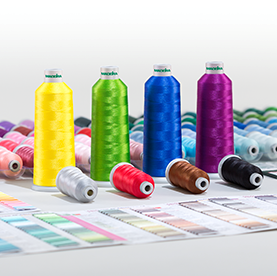

Polyneon polyester
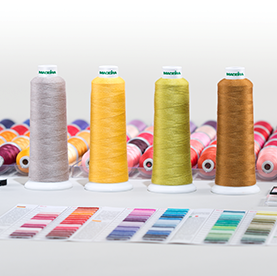
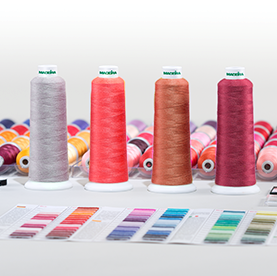
The workhorse. Bright, high-shine polyester that holds its color through chlorine bleach, industrial laundering and sun.
- Fiber
- 100% polyester
- Put-up
- 5,500 yd cones
- Best for
- Uniforms, polos, caps, sportswear
Buckets of Ink · Madeira Authorized Distributor · Tempe, Arizona
Every embroidered logo, monogram and patch is only as good as the thread in the needle. This embroidery thread embroidery guide covers everything that goes through a machine needle, and it is also the shop for it: ten Madeira thread lines from #12 to #150 weight, a thread finder that matches the right line to your job, and the reference charts our counter uses every day.
Embroidery thread is a smooth, lustrous thread engineered to form decorative stitches on the surface of fabric. Machine embroidery thread is a single twisted strand wound on cones or spools, most often 40-weight polyester or rayon, built to run at high speed through a 75/11 needle. Hand embroidery uses stranded cotton floss instead, which is separated into strands and stitched by hand.
Interactive
Pick what you are embroidering. The finder recommends the Madeira line, weight, needle and backing our counter would hand you, and jumps straight to those colors in the catalog below.
Shop Madeira embroidery thread
Search by color name or Madeira color number. Search runs inside the selected line and tells you if the color also exists in another line. Account pricing appears in your cart after login.
Types of embroidery thread
Madeira has made embroidery thread in Germany since 1919. Each line below is a different fiber or construction, which is what changes how the thread looks, how it washes and how it runs. Counts are colors and put-ups we currently stock.
The workhorse. Bright, high-shine polyester that holds its color through chlorine bleach, industrial laundering and sun.
The deepest sheen and softest hand of any embroidery thread. The traditional "embroidery look" for fashion and monograms.
Polyester with a flat, no-shine finish that reads like a printed graphic. Pairs well with glossy Polyneon for contrast.
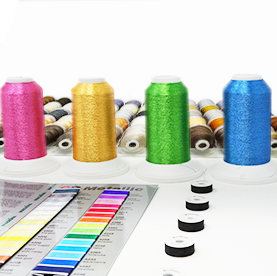
A twisted metallic-effect thread that sparkles without the breakage of flat metallic. Heavier #30 weight for bold coverage.
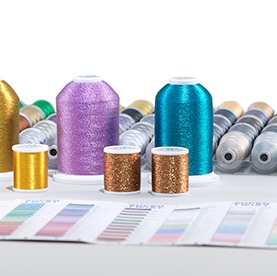
Smooth metallic thread for a true foil look on outlines, crests and logos. Run slower and use a metallic needle.
Madeira's newer metallic construction on a polyester core, developed to run with fewer breaks than traditional metallic.
Flame-resistant embroidery thread for FR garments, so the logo does not become the weak point of the garment.
Invisible nylon thread for applique tack-downs, quilting and bobbin work where the stitch should disappear.
Burmilana #12 is a thick wool-acrylic blend for a hand-stitched, textured look. Sensa Green is Madeira's lyocell thread for sustainable programs.
Which embroidery thread is best?
For most machine embroidery, the best embroidery thread is a 40-weight polyester. It is strong, colorfast and bleach-resistant, which matters because most embroidered garments are uniforms, polos, caps and team wear that get washed hard. Rayon has a softer, silkier sheen and is the traditional choice for fashion, monograms and home décor, but it should not see chlorine bleach. Metallics add shine for accents and need slower speeds and a metallic needle.
A useful rule at the counter: if the garment will be laundered commercially or worn outdoors, use Polyneon. If the customer is paying for the look and will care for the piece, rayon earns its place. Frosted Matt covers the in-between, when the design should look printed rather than stitched.

| Thread | Fiber | Finish | Bleach safe | Needle | Machine speed | Best for |
|---|---|---|---|---|---|---|
| Polyneon #40 | Polyester | High shine | Yes | 75/11 | Full speed | Uniforms, caps, sportswear |
| Classic Rayon #40 | Viscose rayon | Highest sheen | No | 75/11 | Full speed | Fashion, monograms, décor |
| Classic Rayon #60 | Viscose rayon | High sheen, fine | No | 65/9 | Full speed | Lettering under 5 mm |
| Frosted Matt #40 | Polyester | Matte | Yes | 75/11 | Full speed | Vintage, tone-on-tone |
| Supertwist #30 | Metallic effect | Sparkle | Check care | 80/12 | Reduced | Accents, spirit wear |
| FS / CR Metallic | Metallized | Foil | Check care | Metallic 80/12 | Reduced 20–30% | Crests, outlines |
| Fire Fighter #40 | Flame resistant | Satin | Follow FR garment care | 75/11–80/12 | Full speed | FR workwear |
| Burmilana #12 | Wool-acrylic | Textured | Gentle care | 100/16+ | Reduced | Hand-stitched look |
Reference
Thread weight runs backwards: the higher the number, the finer the thread. #40 is the standard for logos and lettering. Move to #60 for small text and fine detail, and to #30 or #20 for bold coverage with fewer stitches. Match the needle to the weight or you will see fraying and breaks.
Relative thickness, not to scale.
| Weight | Typical use | Needle | Satin column | Fill density (start) | Thread used |
|---|---|---|---|---|---|
| #60 | Lettering 3–5 mm, fine outlines | 65/9 | 1.0–3.0 mm | 0.35–0.40 mm | About 5 m of top thread per 1,000 stitches. A 5,000 m cone holds roughly one million stitches. |
| #40 | Logos, lettering 5 mm+, fills | 75/11 | 1.5–8 mm | 0.40–0.45 mm | |
| #30 | Bold text, numbers, heavy coverage | 80/12–90/14 | 2.5–10 mm | 0.50–0.55 mm |
Hand vs. machine
"Embroidery thread" means two different products depending on who is searching. Hand embroiderers and cross-stitchers usually mean six-strand cotton floss such as DMC. Machine embroiderers mean cone-wound polyester or rayon like Madeira. They are not interchangeable, and this is the difference.
| Machine embroidery thread (Madeira) | Hand embroidery floss (e.g. DMC stranded cotton) | |
|---|---|---|
| Construction | Single twisted strand, used as one | Six loosely twisted strands, separated before use |
| Fiber | Polyester, rayon, metallic, specialty | Usually 100% cotton; also silk, rayon, metallic |
| Put-up | Cones (thousands of yards) and spools | Short skeins of about 8 m |
| Weight system | #30, #40, #60 (higher = finer) | Number of strands used (1 to 6) |
| Needle | Machine needle, 65/9 to 90/14 | Hand embroidery or crewel needle, tapestry for cross stitch |
| Speed | Engineered for 800 to 1,200 stitches per minute | Hand stitched |
| Use in an embroidery machine? | Yes, designed for it | No, too thick and loosely plied for machine needles |
| Sold at Buckets of Ink? | Yes, 1,269 Madeira colors | No, find floss at craft and needlework retailers |
How-to
The method depends on whether you are hand stitching with floss or threading a machine head. Both take under two minutes once you have done it a few times.
Care

Embroidery thread ages. Sunlight fades it, heat and dry air make it brittle, and dust drags through the tension discs. Stored well, a cone runs as clean in year two as it did the week it arrived.
Store out of direct sun and away from bright windows. Rayon and cotton fade faster than polyester.
Avoid storage near heaters, dryers and hot warehouse walls. Heat and very dry air make thread brittle and break-prone.
Leave cones in their boxes or a closed cabinet. Dust on the cone ends up packed in the tension discs.
Organize by Madeira line and color number, not by hue, so pulls always match the digitized file.
Put thread nets on polyester and metallic cones so loops do not slide off the base and snag.
Date new cones and run the oldest first. Keep lot numbers with large-job colors.
Troubleshooting
Replace the needle first and make sure it is fully seated with the scarf to the rear. Recheck the thread path for a missed guide. Loosen top tension a quarter turn. For metallic thread, slow the machine and switch to a metallic needle. Old, dry thread breaks more; test a fresh cone of the same color.
Fraying means the eye is too small for the thread or the needle is burred. Go up one needle size, replace worn needles every 8 to 10 run hours, and check the needle plate hole for nicks.
Top tension is too loose, or the thread has jumped out of the tension disc. Rethread with the presser foot raised and tighten top tension slightly.
Top tension is too tight or bobbin tension too loose. Clean lint from under the bobbin case spring and check the bobbin case with a drop test before adjusting top tension.
Let metallic feed off the top of the cone from a stand behind the machine, add a thread net, slow the head 20 to 30 percent and use a metallic needle with an elongated eye. Supertwist is the easier alternative when sparkle, not foil, is the goal.
Where to buy embroidery thread
Buckets of Ink is a stocking Madeira distributor. Shops across Tempe, Phoenix, Mesa, Chandler, Gilbert, Scottsdale and Glendale can walk in with a color list and leave with it, or get it on our delivery route. Everyone else gets the same stock shipped from our Arizona warehouse. For local stock and hours, see embroidery thread near me.

906 S Priest Dr #101
Tempe, AZ 85281
480-229-7806 · bucketsofink@gmail.com
Monday to Friday · 7:30 AM to 4:00 PM

Stocking up on the rest of the kit? See embroidery supplies, embroidery scissors and Happy Japan embroidery machines.
Questions we answer at the counter
For most machine embroidery, 40-weight polyester such as Madeira Polyneon is the best all-round thread. It is strong, colorfast and bleach-resistant, runs at full machine speed on a 75/11 needle, and holds up on uniforms, caps and sportswear that are laundered hard.
Machine embroidery thread is a single twisted strand wound on cones or spools and sized by weight (#30, #40, #60). Embroidery floss, such as DMC stranded cotton, is six loosely twisted cotton strands sold in short skeins that you separate and stitch by hand. Floss is for hand embroidery and cross stitch; machine thread is for embroidery machines.
No. Six-strand cotton floss is too thick and too loosely plied to pass cleanly through a machine needle at embroidery speeds. Use machine embroidery thread; Madeira and other brands publish color charts if you need to match a floss color.
Polyester is better for anything washed hard, bleached or worn outdoors: uniforms, workwear, caps and team apparel. Rayon has a softer, silkier sheen and is preferred for fashion, monograms and home decor, but it should not be exposed to chlorine bleach.
Use #40 for most logos, lettering and fills. Use #60 for lettering under 5 mm and fine detail with a 65/9 needle. Use #30 or #20 for bold text and heavier coverage with fewer stitches on an 80/12 to 90/14 needle.
A common estimate is about 5 meters of top thread per 1,000 stitches. An 8,000-stitch left-chest logo in one color uses roughly 40 meters, so a 5,000 meter cone holds about one million stitches.
It will stitch, but all-purpose sewing thread is less lustrous and less consistent at embroidery speeds, so fills look dull and break more often. Embroidery thread is engineered for high-speed needle penetration and even sheen.
Keep it out of direct sunlight, away from heat and very dry air, and covered from dust, ideally in the original boxes or a closed cabinet. Organize by line and color number, use thread nets on slippery cones, and run the oldest cones first.
Buckets of Ink stocks 1,269 Madeira embroidery thread colors at 906 S Priest Dr #101 in Tempe, AZ, open Monday to Friday 7:30 AM to 4:00 PM, with delivery across the Phoenix metro and shipping to every state.
Yes. Buckets of Ink is a Madeira distributor. Registered shops see account pricing in the cart after login, and case quantities are quoted directly. Call 480-229-7806 to set up an account.
No. Buckets of Ink stocks machine embroidery thread and supplies for embroidery machines. For DMC floss and hand embroidery kits, a craft or needlework retailer is the better source.
Madeira thread is labeled with an article number for the line and put-up and a color number, for example 918-1800. Each line has its own color numbering, so Emerald Black is 1000 in Classic Rayon but 7800 in Frosted Matt. Use a conversion chart when switching lines.
Cite this page: Buckets of Ink. "Embroidery Thread Embroidery: Madeira Machine Embroidery Thread Guide and Catalog." bucketsofink.com/page/embroidery-thread-embroidery. Updated September 28, 2026.